
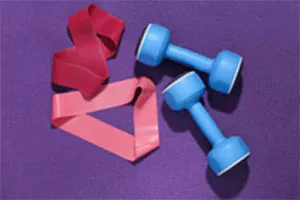
When we do resistance training in Strong Bones class, you might wonder why we sometimes use dumbbells and other times elastic resistance bands. Both options make our muscles work harder, but is one type of resistance better than the other? The short answer is yes.
While weight-bearing exercise uses gravity to load your bones (such as walking or climbing stairs), resistance training challenges your muscles by having them work against an external force. That force can come from free weights (dumbbells, kettlebells, or barbells), resistance bands, weight machines, or even your own body weight.
Both resistance bands and free weights can improve strength, balance, and everyday function. In fact, a recent randomized clinical trial found that resistance band training and free weight training produced similar improvements in physical function in older adults (1).
So, if both work, why do we use dumbbells more often in Strong Bones class?
Resistance Bands
Resistance bands are inexpensive, lightweight, portable, and easy on the joints. They come in different colors and thicknesses that represent different levels of resistance when they are stretched.
However, there’s one important limitation: the resistance changes throughout the movement. At the beginning of an exercise, the band provides relatively little resistance. As the band stretches, the resistance gradually increases, reaching its maximum only near the very end of the movement. That doesn’t make bands ineffective, it simply means your muscles are not challenged equally throughout the entire exercise.
Free Weights
Free weights work differently. A 10-pound dumbbell weighs 10 pounds at the beginning, middle, and end of every repetition. Your muscles must work against that load throughout the movement. More importantly, for people concerned about bone health, standing exercises performed with free weights expose the skeleton to something called axial loading.
Why Axial Loading Matters
Axial loading simply means that weight is transmitted vertically through your body.
Imagine holding a pair of dumbbells while performing a squat. Gravity pulls the weights straight down through your shoulders, spine, pelvis, and legs. Your bones respond and adapt to these beneficial compressive forces over time – a key principle behind improving or maintaining bone strength.
Resistance bands can certainly strengthen muscles, but they don’t provide axial loading because the force comes from the stretched band rather than from gravity acting on an external weight.
The Bottom Line
My advice? Use both but choose free weights more often because they provide a stronger stimulus for bone building. Resistance bands are still worthwhile and can offer variety, convenience, and flexibility to your workouts.
Reference
- Schott N, Straßer P, Holfelder B. Effects of Elastic Band Training Versus Free Weight Training in Community-Dwelling Older Adults: A Randomized Controlled Trial. Experimental Gerontology 2026;221:113182.